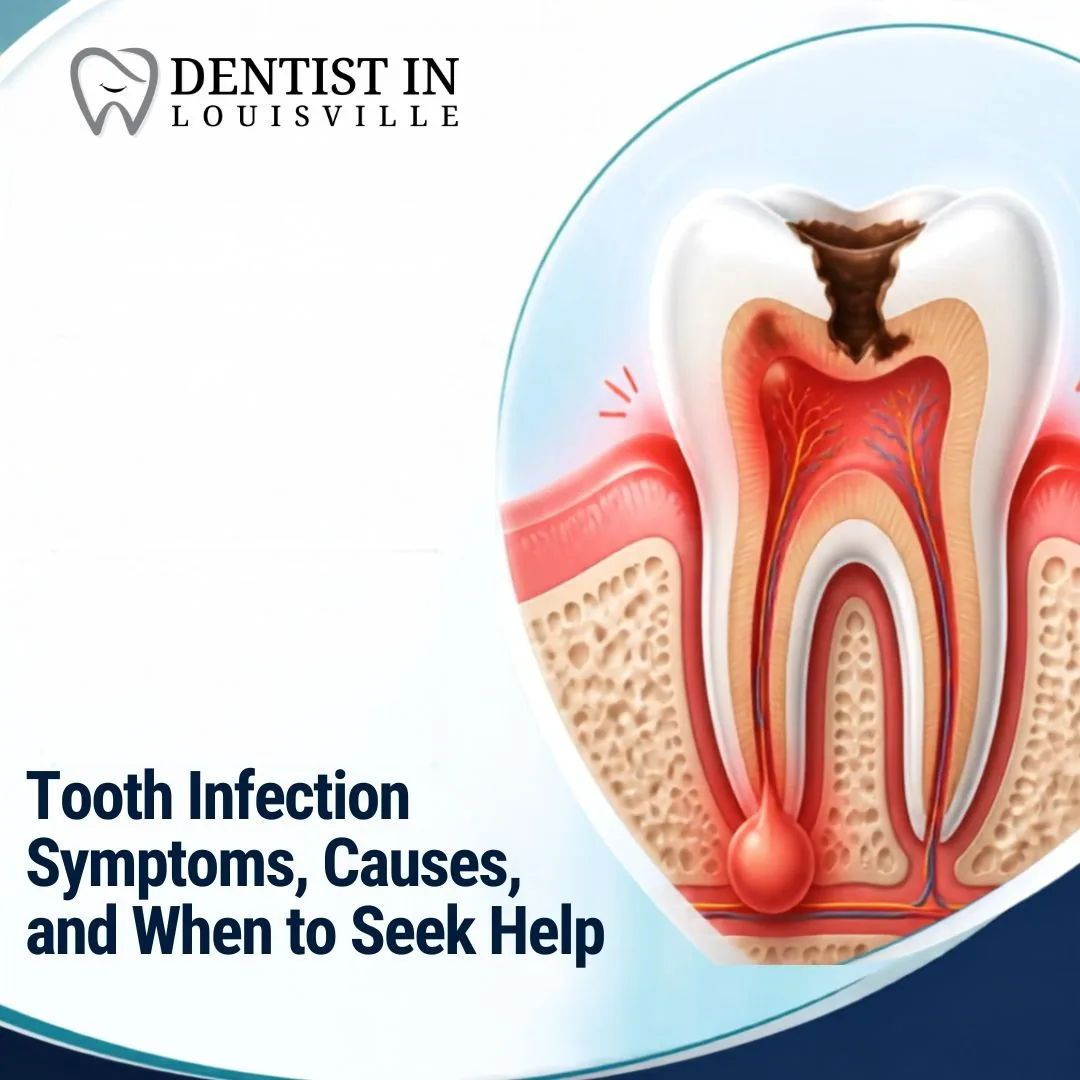
Most tooth infections announce themselves in the middle of the night. The pain is sharp, then constant, then throbbing. Hot coffee stings. Chewing on that side hurts. A red bump appears on the gum, and you start to feel genuinely unwell.
That combination usually means a tooth abscess — a pocket of pus caused by a bacterial infection at the root of a tooth or in the surrounding gum. Unlike a cavity, an abscess does not wait politely for your next checkup. Here's how to recognize it, what causes it, and when to stop searching and call an emergency dentist in Louisville.
A tooth infection rarely shows up as one symptom on its own. Watch for these together:
One warning worth knowing: if the pain suddenly disappears on its own, the infection has not resolved. It often means the nerve inside the tooth has died while the bacteria keep spreading. That is still an emergency.
Bacteria need a way into the inner tooth. They usually find one of these four:
Some people are at higher risk: anyone with diabetes or a weakened immune system, patients on immunosuppressive medication, heavy smokers, and anyone with a dry mouth from medication. In those cases an infection spreads faster and deserves faster care.
Call our office the same day for throbbing pain, pressure sensitivity, or a visible bump on the gum. We keep same-day slots open for exactly this.
Some signs mean urgent care right now — call 502-239-9751, or go to the nearest emergency room if you cannot reach us:
Antibiotics from an urgent care visit can calm swelling, but they do not cure an abscess. The infection lives inside a tooth that has no blood supply left, so it comes back until the source is treated by a dentist.
Treatment starts with getting you out of pain, then removing the source of the infection:
For a closer look at each step, read our guide to how dentists stop an abscess fast.
Almost every abscess we treat started as something small and silent. Brush twice daily, floss between the teeth where cavities begin, keep your six-month exam and cleaning, and fix small cavities while they are still small and painless. If a tooth has been quietly sensitive for weeks, that is the moment to have it looked at — not after it wakes you at 2 a.m.
If you have dental pain, swelling, or a bump on the gum, call Dentist in Louisville at 502-239-9751. We're at 6826 Bardstown Road, Louisville, Kentucky, 40291, and we hold time each day for tooth infection treatment so you're not waiting out an infection over a weekend.
Severe throbbing pain, lingering sensitivity to hot and cold, pain when biting, a red or swollen bump on the gum, a bad taste from draining pus, facial swelling, and sometimes fever. Several of these together strongly suggest an abscess.
Bacteria reaching the inner tooth — most often through deep decay, a crack or broken tooth, untreated gum disease, or a failing old filling or crown. Once inside the pulp, the infection forms a pocket of pus at the root.
Call the same day for throbbing pain, pressure sensitivity, or a gum bump. Seek urgent care immediately for a fever over 100.4°F, spreading facial or neck swelling, or any difficulty breathing, swallowing, or opening your mouth.
No. If the pain stops on its own, it usually means the nerve has died while the bacteria continue spreading into the bone. Antibiotics alone can reduce swelling but cannot cure an abscess — the source has to be treated.
The dentist drains the infection, prescribes antibiotics when it has spread, and then removes the source — usually a root canal to save the tooth, or an extraction if the tooth is too damaged to keep.
Brush twice a day, floss daily, keep six-month checkups and cleanings, and treat small cavities and early gum disease before bacteria reach the nerve.
Ready to talk to a dentist in Louisville, KY? Learn more about tooth infection treatment in Louisville, root canal treatment and same-day emergency dental care, or get in touch below.
Tell us a little about what you need — we'll be in touch shortly.
6826 Bardstown Road, Louisville, Kentucky, 40291, USA
Hi! I'm Tooth fairy! Your AI Assistant Ask me anything